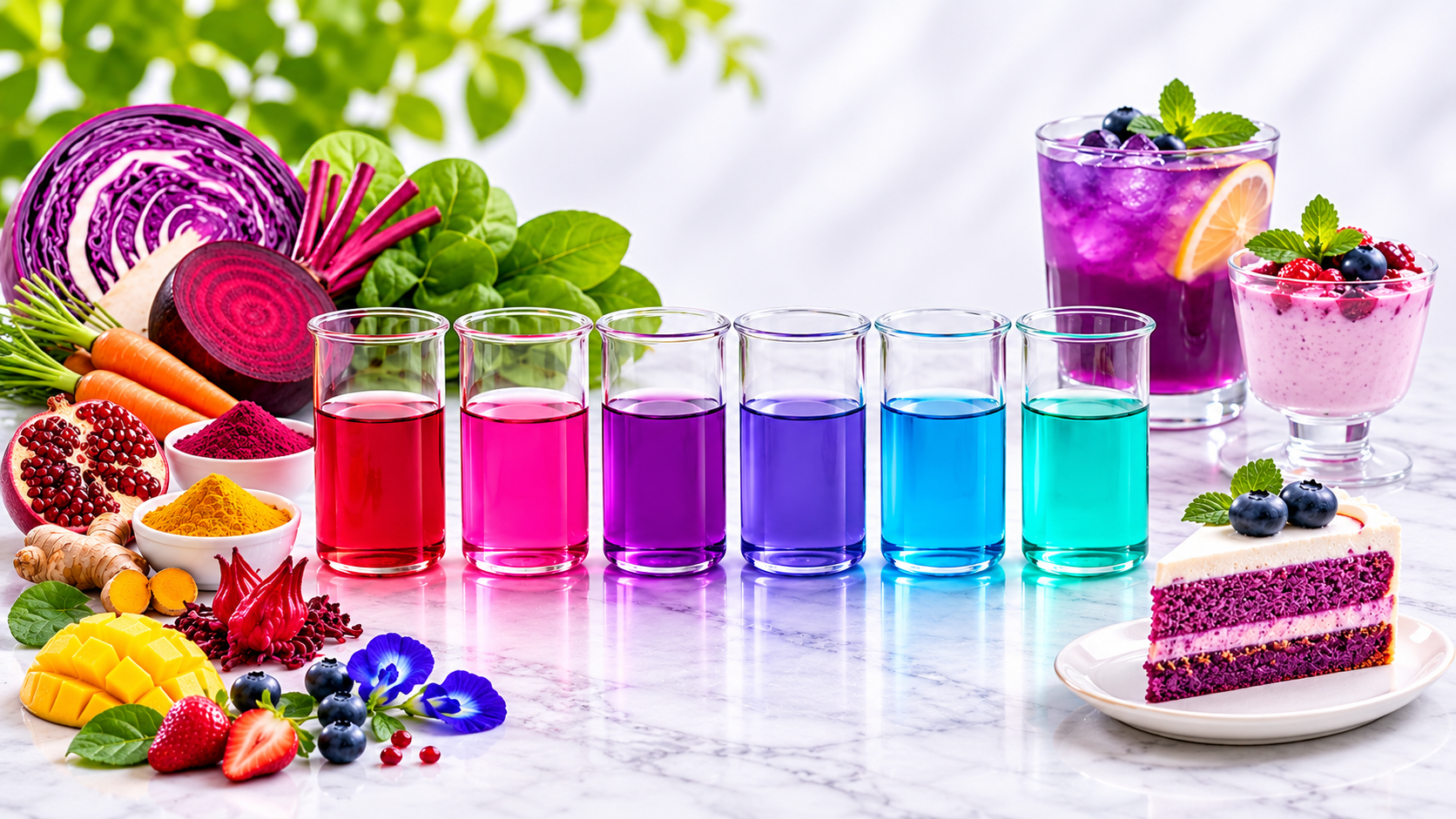
Natural or synthetic food colours, which is the better choice? The answer depends on the desired shade, processing conditions, food formulation and shelf-life requirements. While natural food colours offer opportunities for clean-label product development, synthetic colours may provide advantages in colour intensity and consistency in certain applications.
Colour plays an important role in how consumers perceive food, influencing expectations of flavour, freshness and product quality. From vibrant confectionery and refreshing beverages to golden bakery products, food colour helps create a product’s visual appeal.
As consumers increasingly seek recognizable ingredients and clean-label products, natural food colours are gaining attention as alternatives to synthetic colour additives. However, choosing the right colour requires more than considering its source. Understanding the characteristics, benefits and limitations of each type is essential for achieving the desired result in food manufacturing.
Why Is Food Colouring Used in Food Products?
Food colouring is not simply added to make products look attractive. It serves several important functions in food manufacturing, including:
- Enhancing visual appeal: Making products more attractive to consumers.
- Restoring colour: Replacing colour lost during processing, heating or storage.
- Improving consistency: Maintaining a uniform appearance between production batches.
- Supporting flavour perception: Reinforcing familiar colour associations, such as yellow for lemon and red for strawberry.
Food colours are used to restore colour lost during processing and storage, enhance naturally occurring colours or add colour to foods that would otherwise look different.1
What Are Natural Food Colours?
Natural food colours are obtained from sources such as fruits, vegetables, plants, algae and certain animals. They contain naturally occurring pigments that provide a variety of colours, making them attractive ingredients for manufacturers developing products with natural-source ingredients.
Some common natural food pigments include:2
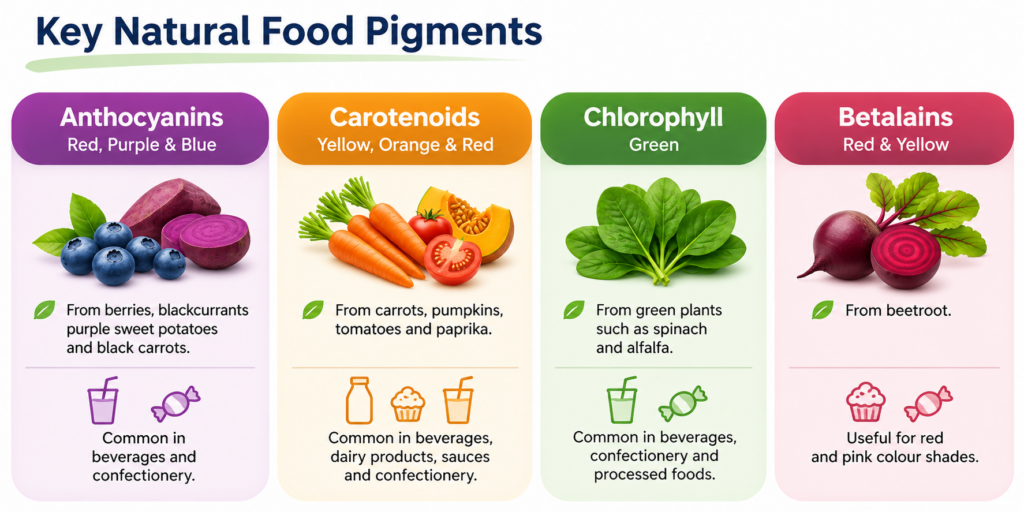
These pigments provide manufacturers with a diverse colour palette derived from natural sources. Their performance, however, depends on the pigment type and the conditions of the food formulation.2
What Are Synthetic Food Colours?
Synthetic food colours are manufactured through chemical processes to produce specific and consistent colouring properties. They have traditionally been used in food manufacturing because of their strong colour intensity, consistency and versatility.
Common examples include:1
- Tartrazine (E102): Bright yellow
- Sunset Yellow FCF (E110): Orange-yellow
- Allura Red AC (E129): Vibrant red
- Brilliant Blue FCF (E133): Bright blue
- Indigotine (E132): Blue to indigo
These colours are used in various food applications, including confectionery, beverages, desserts, bakery products and snacks. Their functional advantages include strong colouring performance, consistent shades and ease of blending to achieve different colours.
As consumer interest in clean-label products grows, manufacturers are also exploring natural alternatives that can meet their formulation and product requirements.
Natural vs Synthetic Food Colours: What Are the Key Differences?
Although natural and synthetic food colours serve the same primary purpose, their sources and functional properties differ.
Consideration | Natural colours | Synthetic colours |
Source | Fruits, vegetables, plants, algae and certain animals | Manufactured through chemical processes |
Colour intensity | Varies depending on pigment and concentration | Generally strong and vibrant |
Stability | Some pigments are sensitive to heat, light, oxygen and pH | Many offer good stability across different conditions |
Consumer perception | Often associated with natural and clean-label positioning | May face greater scrutiny from consumers |
Cost | Can be higher depending on sourcing and extraction | Generally, more cost-effective |
These are general comparisons, as performance varies between individual colourants. Nevertheless, natural food colours offer manufacturers an opportunity to develop products that respond to growing interest in natural-source ingredients.
Are Natural Food Colours Safe?
Natural food colours are often perceived as healthier because of their natural origins. However, natural does not automatically mean safer. The safety of any food colour depends on its composition, purity, permitted usage level and scientific safety assessment.
Importantly, food colour regulations vary between countries. Not all colours are approved for every market or food application. Manufacturers should therefore check the relevant local regulations to ensure that their selected colour is permitted for the intended food category, usage level and labelling requirements.1
Ultimately, choosing a food colour requires not only considering its functionality but also ensuring regulatory compliance in the target market.
What Should Manufacturers Consider When Using Natural Food Colours?
Although natural food colours offer exciting opportunities, selecting the right pigment is essential to achieving the desired product appearance and shelf-life performance.
Some important formulation considerations include:2
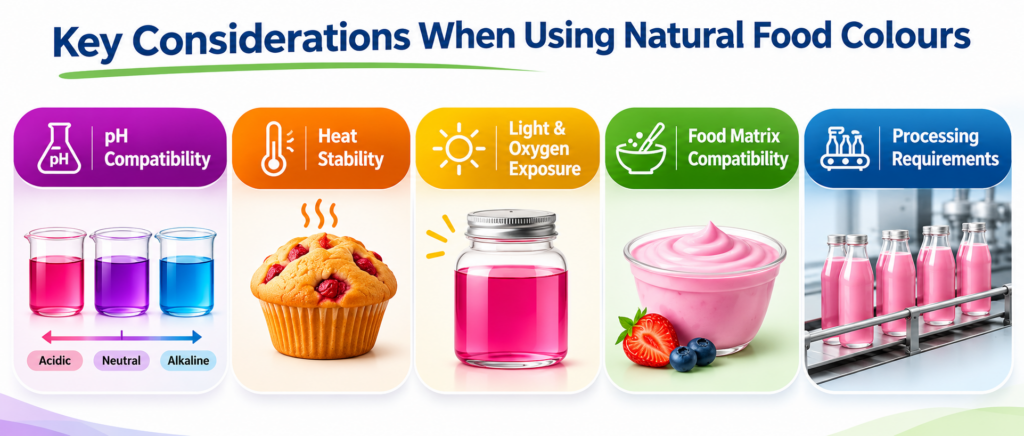
Maintaining natural colour performance requires careful consideration of pH, heat, light, oxygen exposure, food matrix compatibility and processing conditions.2
To address these challenges, research has explored various approaches to improve natural pigment stability, including pH adjustment, encapsulation and the use of antioxidants.2 Advanced processing technologies such as micronization can also improve pigment dispersion, while encapsulation helps protect sensitive pigments and enhance their stability in food formulations.4
These technologies provide opportunities for manufacturers to achieve better colour performance and expand the use of natural pigments across different food applications.
Evaluating Anthocyanin Colour Stability in an Acidic Berry Beverage
Anthocyanins, naturally found in berries and other colourful plants, are sensitive to pH, which influences their colour expression and stability.
Anthocyanin colour depends on pH, pigment source and formulation. As pH changes, the pigments may change shade or lose colour, while higher pH can reduce stability.2
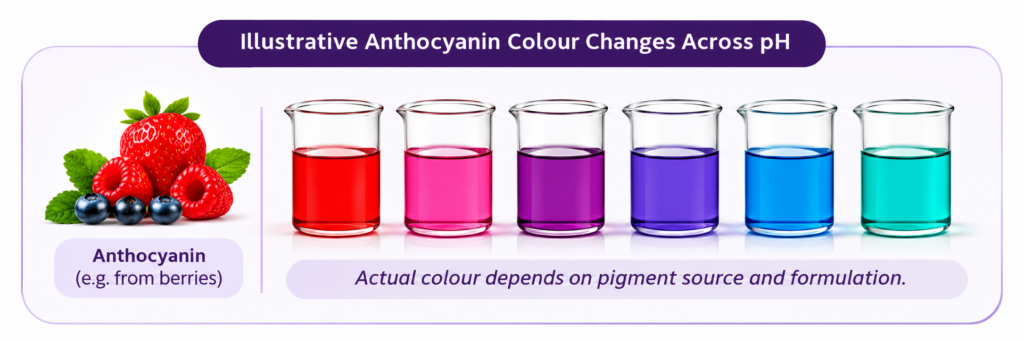
For an acidic berry beverage, manufacturers can evaluate anthocyanin-based colours through several formulation tests:2
- Finished beverage pH: Assess the colour shade and intensity at the formulation’s target pH to determine whether it delivers the desired colour.
- Heat processing: Compare colour appearance before and after the intended heat treatment to evaluate potential changes during processing.
- Storage stability: Monitor colour intensity and shade throughout the product’s intended shelf life to identify potential fading or colour changes.
These evaluations help manufacturers determine whether the selected pigment achieves the desired appearance and maintains acceptable colour performance under the formulation’s actual processing and storage conditions.2
Finding the Right Natural Food Colour with DPO International and NECOL™
Switching to natural food colours requires more than simply replacing one colourant with another. Manufacturers need to consider the desired shade, formulation compatibility, colour stability and processing conditions to achieve the best results.
Through our partnership with Symega Food Ingredients, DPO International brings NECOL™, a range of natural colour solutions made from selected plant-based pigments and extracts, to food manufacturers in Malaysia, Indonesia and Vietnam. Available in powder and liquid formats, NECOL™ offers a variety of colour options and customized shades for applications ranging from beverages and dairy to bakery, confectionery and snacks.
Combining NECOL™’s ingredient innovation with DPO International’s ingredient knowledge and technical application support, we help manufacturers identify suitable natural colour solutions based on their product requirements.
Discuss your application with DPO to explore natural colour solutions for your next product innovation.
For further insights into food colour regulations and the use of synthetic colours and natural alternatives, explore our related article on synthetic food colours and natural alternatives.