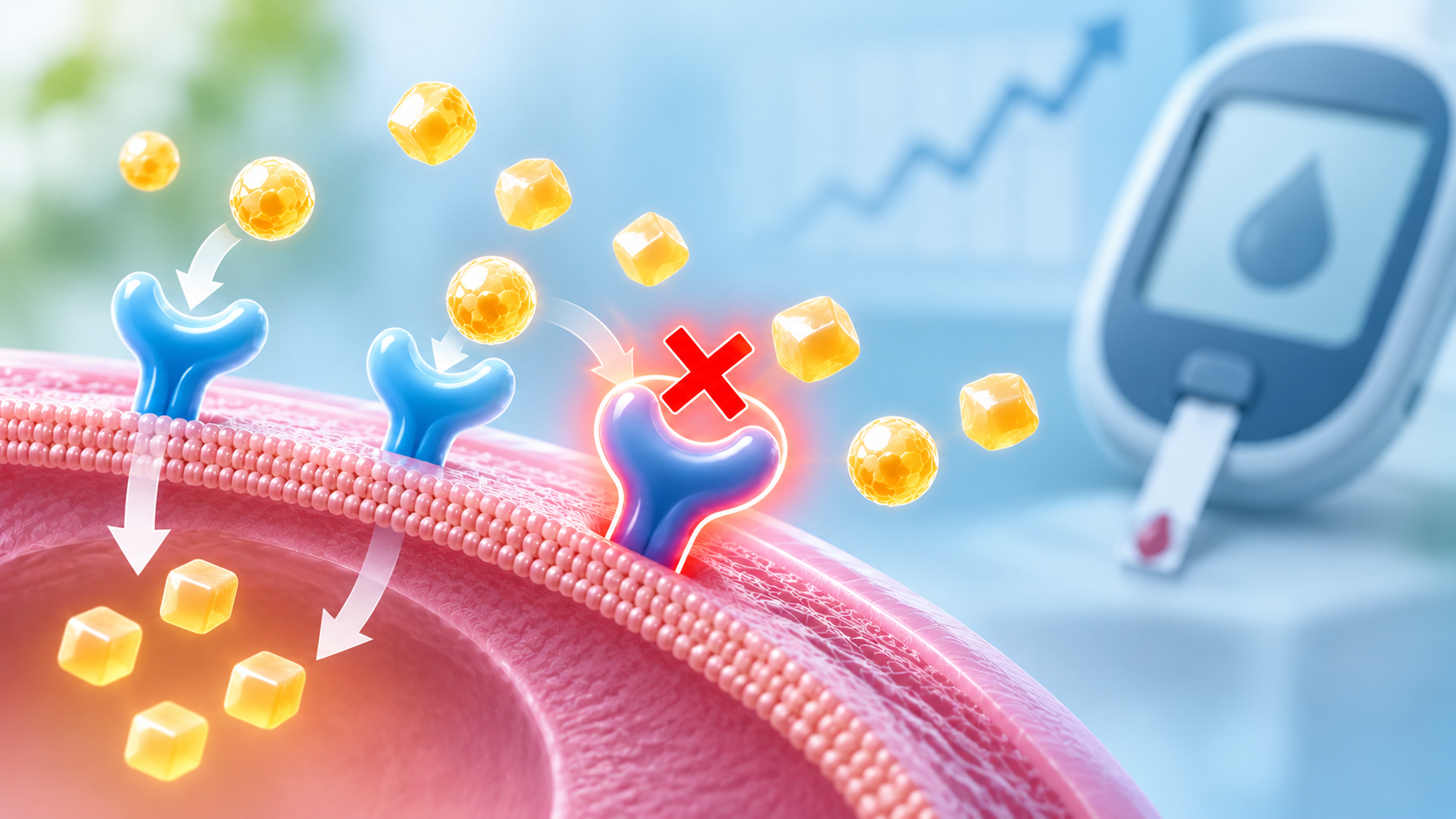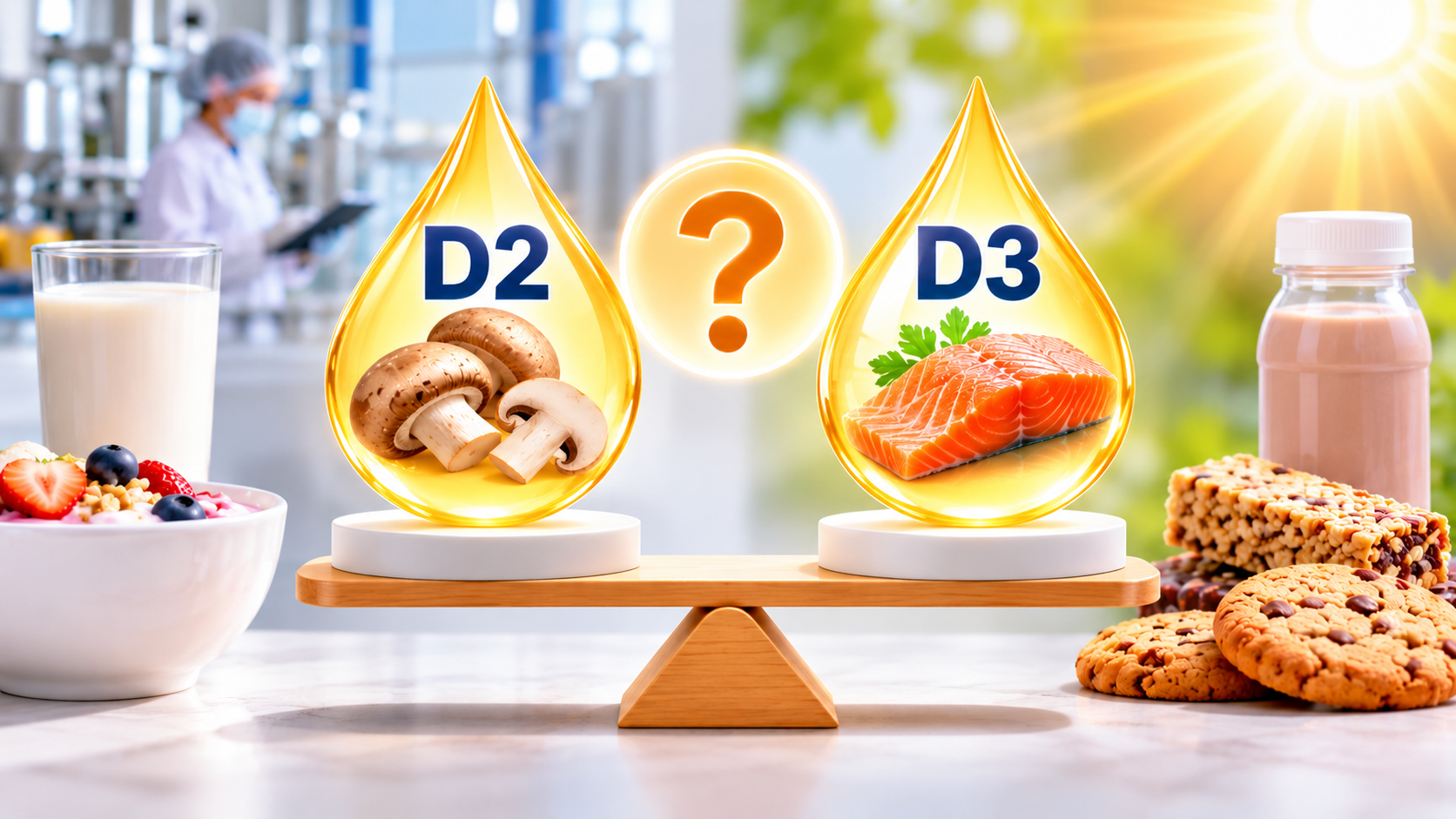
Consumers increasingly search for answers to questions such as “What is the difference between Vitamin D2 and D3?”, “Can I take Vitamin D2 and D3 together?” and “Is Vitamin D3 the same as vitamin D from the sun?”. These questions highlight a growing awareness of vitamin D’s role in health and the importance of maintaining adequate vitamin D status.
For food and beverage manufacturers, this trend presents both an opportunity and a challenge. With food fortification becoming an important consideration in functional food and beverage development, selecting the appropriate vitamin D ingredient is an important formulation decision.
The two major forms used in food fortification are Vitamin D2 (ergocalciferol) and Vitamin D3 (cholecalciferol). While both can increase vitamin D intake, they differ in source, metabolism and, according to some clinical evidence, their ability to raise circulating vitamin D levels.
This article explores the science behind Vitamin D2 and Vitamin D3 and discusses what product developers should consider when selecting vitamin D ingredients for food applications.
What Is Vitamin D?
Vitamin D is a fat-soluble vitamin that helps regulate calcium and phosphorus balance in the body, supporting normal bone mineralization and skeletal health [1].
Vitamin D obtained from sunlight, food or supplements must first be converted into 25-hydroxyvitamin D [25(OH)D], the primary marker used to assess vitamin D status, before being further activated in the body [1].
Key Functions of Vitamin D
According to the NIH and the Endocrine Society, vitamin D contributes to [1, 5]:
- Calcium absorption
- Maintenance of normal blood calcium concentrations
- Bone growth and remodeling
- Prevention of rickets in children
- Prevention of osteomalacia in adults
- Support of normal neuromuscular function
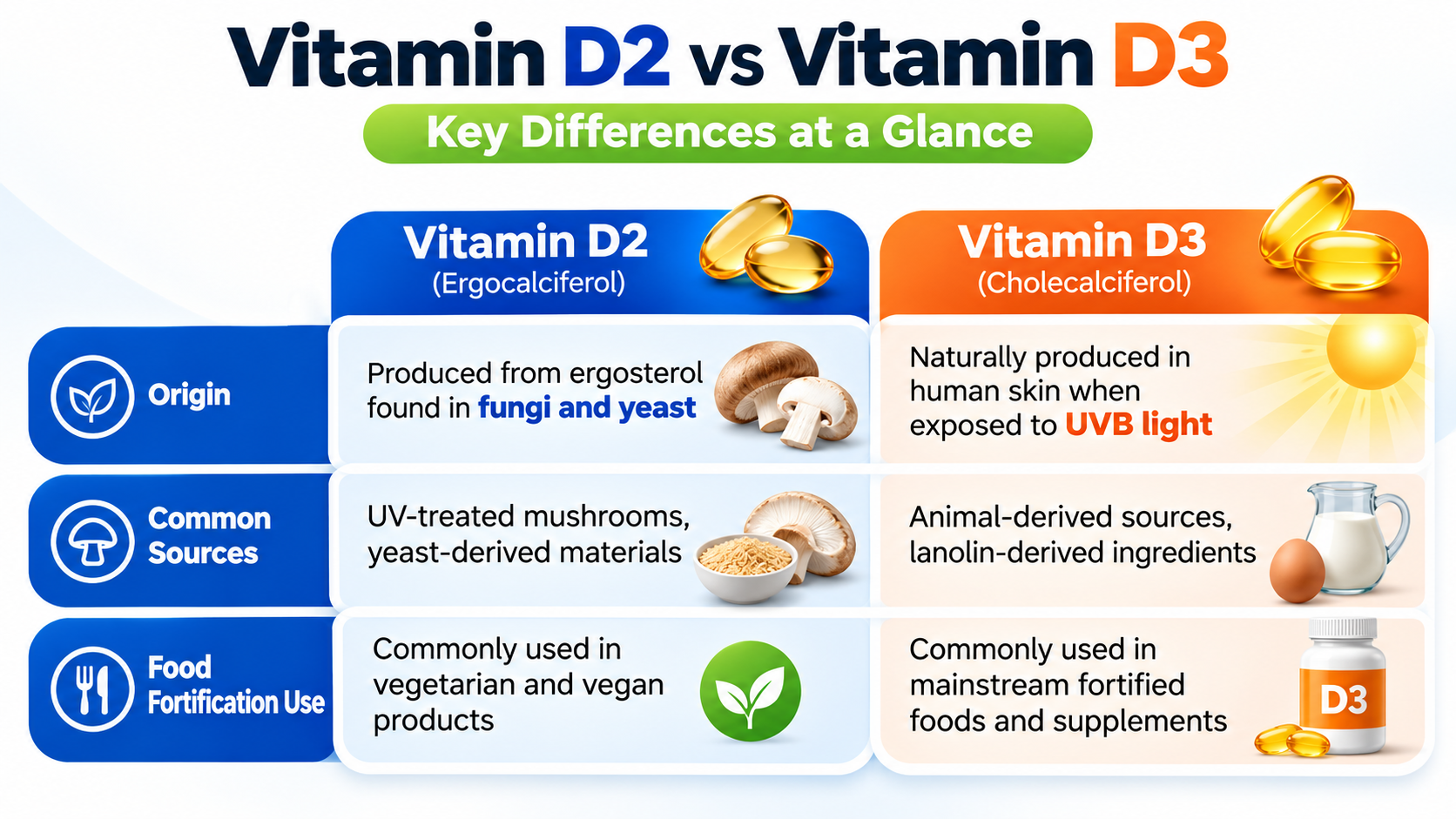
Sources of Vitamin D2 and Vitamin D3
Do Vitamin D2 and D3 Work Differently in the Body?
Both vitamins have the same primary function. Both forms are converted into 25(OH)D in the liver and eventually become physiologically active vitamin D metabolites [1].
However, studies show that vitamin D2 and vitamin D3 differ in their effectiveness in raising and maintaining blood vitamin D levels. While both forms help support vitamin D status and normal physiological functions, vitamin D3 is generally more effective than vitamin D2 at increasing and maintaining circulating 25-hydroxyvitamin D [25(OH)D] concentrations [2].
Can Vitamin D2 and D3 be used at the same time?
Yes. Vitamin D2 (ergocalciferol) and vitamin D3 (cholecalciferol) can be administered together, although combining both forms does not necessarily provide additional benefits over using either form alone. Vitamin D is also frequently formulated alongside vitamin K, particularly vitamin K2, because both nutrients contribute to bone metabolism [4].
Clinical Evidence Comparing D2 and D3
A landmark systematic review and meta-analysis by Tripkovic et al. (2012) evaluated randomized controlled trials directly comparing Vitamin D2 and Vitamin D3 supplementation [2]. The authors reported that supplementation with vitamin D3 had a significant and positive effect in increasing of serum 25(OH)D concentrations compared with the effect of vitamin D2 [2].
A 2023 systematic review and meta-analysis involving 39 studies found beneficial effects of Vitamin D3 supplementation on lumbar spine and femoral neck bone mineral density measures, although effects varied by skeletal site [3].
In a 2026 systematic review and meta-analysis involving 26 articles, Vitamin D2 supplementation has also been shown to increase vitamin D status and contribute to parathyroid hormone (PTH) regulation which affects calcium balance and influences bone turnover [8].
What Are the Signs and Potential Consequences of Vitamin D Deficiency?
Common symptoms associated with vitamin D deficiency may include [1]:
• Bone pain
• Muscle weakness
• Increased fracture risk
• Fatigue
However, deficiency can also be asymptomatic, highlighting the importance of adequate intake through sunlight, food, fortified products or supplementation.
What Do Consumers Really Want When It Comes to Vitamin D Products?
The answer is simple. Consumers want a reliable source of Vitamin D that helps them maintain adequate vitamin D status despite everyday lifestyle challenges. In reality, lifestyle, physiological and dietary factors can make it difficult for individuals to maintain adequate vitamin D status.
Research identifies people with occupations that limit sun exposure, homebound individuals and those who regularly cover most of their skin as groups more likely to have inadequate vitamin D status. Skin pigmentation also matters, as higher melanin content reduces the skin’s ability to produce vitamin D from sunlight [1]. Ageing can further reduce the skin’s capacity to synthesize vitamin D [9]. Meanwhile, obesity presents another challenge: individuals with a BMI of 30 or above generally have lower circulating 25-hydroxyvitamin D [25(OH)D] concentrations, partly because greater amounts of body fat can sequester vitamin D and influence its distribution and availability in circulation [10].
Adding to these challenges, naturally occurring dietary sources of vitamin D are relatively limited, making it difficult for many people to obtain sufficient amounts through food alone. This creates an important opportunity for vitamin D-fortified foods and beverages.
What Does This Mean for Product Developers?
These challenges present an opportunity for food manufacturers to develop vitamin D-fortified foods and beverages that help consumers increase their dietary vitamin D intake. The challenge is ensuring that the vitamin D content (regardless of whether vitamin D2 or vitamin D3 is selected) remains stable during storage and effectively delivered via the food matrix of choice. While both forms can be used to fortify foods, manufacturers must evaluate:
• Desired nutritional positioning
• Vegetarian or vegan requirements
• Regional regulatory considerations
• Target consumer preferences
• Stability and formulation needs
The choice is therefore not solely about biological efficacy but also formulation objectives and market positioning. For example, Vitamin D2 would be a suitable option for vegan-positioned products because it can be sourced from non-animal materials. However, it is reported that Vitamin D2 requires protection from UV or photolytic degradation [11] despite being able to withstand pasteurization and heat treatment in fluid milk application just like Vitamin D3 [6]. Hence, if Vitamin D2 is to be selected for certain plant-based milk applications, it is recommended to incorporate it into lipid-based or polysaccharide-based delivery systems to increase stability and improve protection against environmental degradation such as UV damage [7]. It is also reported that certain packaging like glass bottles can help sustain Vitamin D2 content against photodegradation in a liquid dairy milk application [6].
Why Work with DPO International
Selecting a fortification ingredient is only one part of a successful product launch.
As a one-stop ingredient solutions provider and full-suite market enabler, DPO International connects F&B manufacturers with ingredient solutions while supporting ingredient sourcing and product development requirements across functional foods, beverages and nutritional products.
Whether the objective is vegan-friendly fortification using Vitamin D2 or mainstream fortification using Vitamin D3, access to the right ingredient partner is crucial can simplify development and accelerate market readiness.
Conclusion
Vitamin D2 (ergocalciferol) and Vitamin D3 (cholecalciferol) both play important roles in helping consumers achieve adequate vitamin D intake.
However, current clinical evidence indicates that Vitamin D3 may be more effective than Vitamin D2 at increasing circulating 25(OH)D levels [2]. At the same time, Vitamin D2 remains an important option for vegetarian and vegan applications.
By connecting manufacturers with ingredient solutions such as Hexagon Nutrition’s Vitamin and Mineral portfolio, DPO International helps businesses make informed ingredient decisions while supporting broader product development goals.