Understanding the difference between halal vs kosher is essential for any business operating in the food industry. Both terms appear on product labels, supplier documentation, and export certifications across the globe — yet halal and kosher are frequently confused or conflated.
Both are religious dietary frameworks, and both govern what is permissible to produce, sell, and consume. But the rules are meaningfully different, the certification pathways are separate, and the market implications — particularly across Southeast Asia — are distinct.
This guide breaks down the key differences between halal and kosher in plain language, with a focus on what matters most to food manufacturers, ingredient suppliers, and foodservice operators in the region.
What Is Halal?
‘Halal’ is an Arabic word meaning ‘permissible’ or ‘lawful’. In the context of food, it refers to anything that is allowed under Islamic law (Sharia). A Halal-certified product confirms that every stage of its production — from raw ingredients to processing, packaging, and storage — complies with Islamic dietary requirements.
For food businesses, understanding what Halal permits and prohibits is the first step to ensuring your products are compliant across Southeast Asian markets where Halal certification is a mandatory procurement requirement.
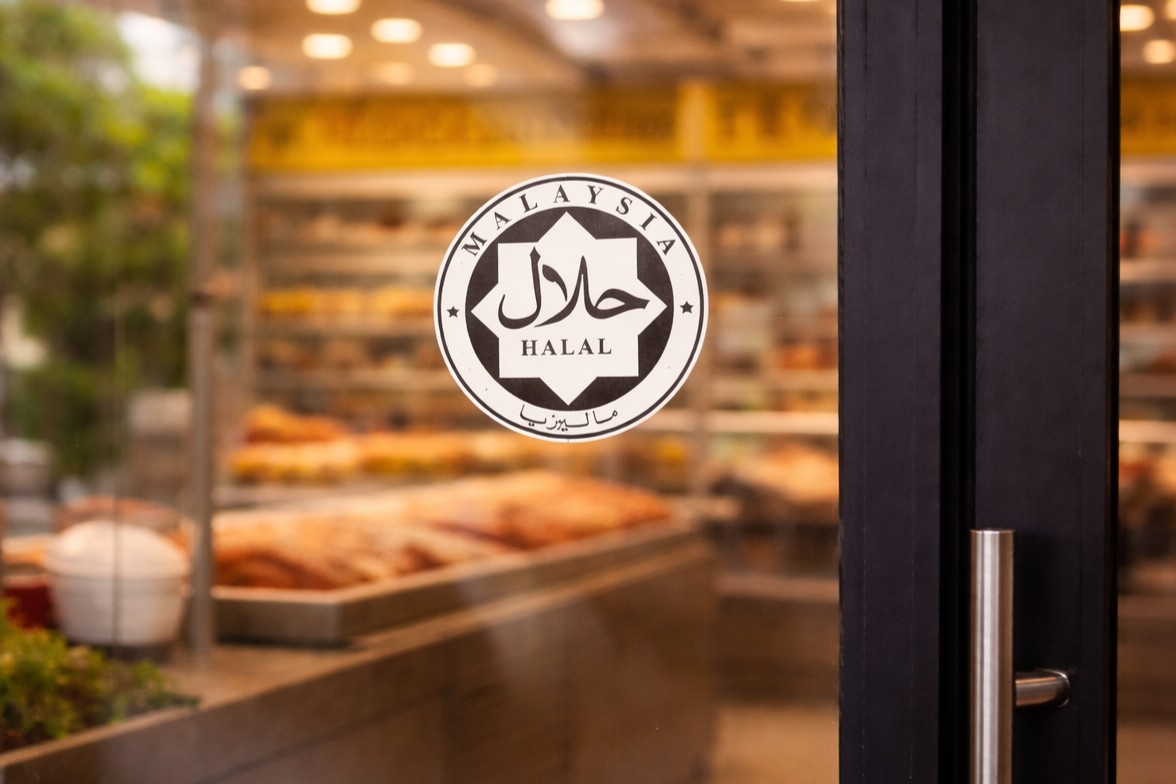
What Halal permits and prohibits
- All edible aquatic animals are permitted — including fish, shellfish, crustaceans, and other seafood
- Beef, lamb, goat, and poultry are permitted, provided they are slaughtered correctly
- Pork and all pork derivatives are strictly prohibited
- Alcohol and any food or ingredient containing alcohol is forbidden
- Animal blood is prohibited and must be fully drained during slaughter
The Halal slaughter method (Dhabihah)
For meat to be Halal, the animal must be slaughtered by a Muslim who recites the name of Allah (Bismillah) before each cut. The throat, windpipe, and blood vessels of the neck must be severed with a sharp blade in a single, swift motion to minimise suffering. The blood must then drain completely from the carcass before the meat is processed.
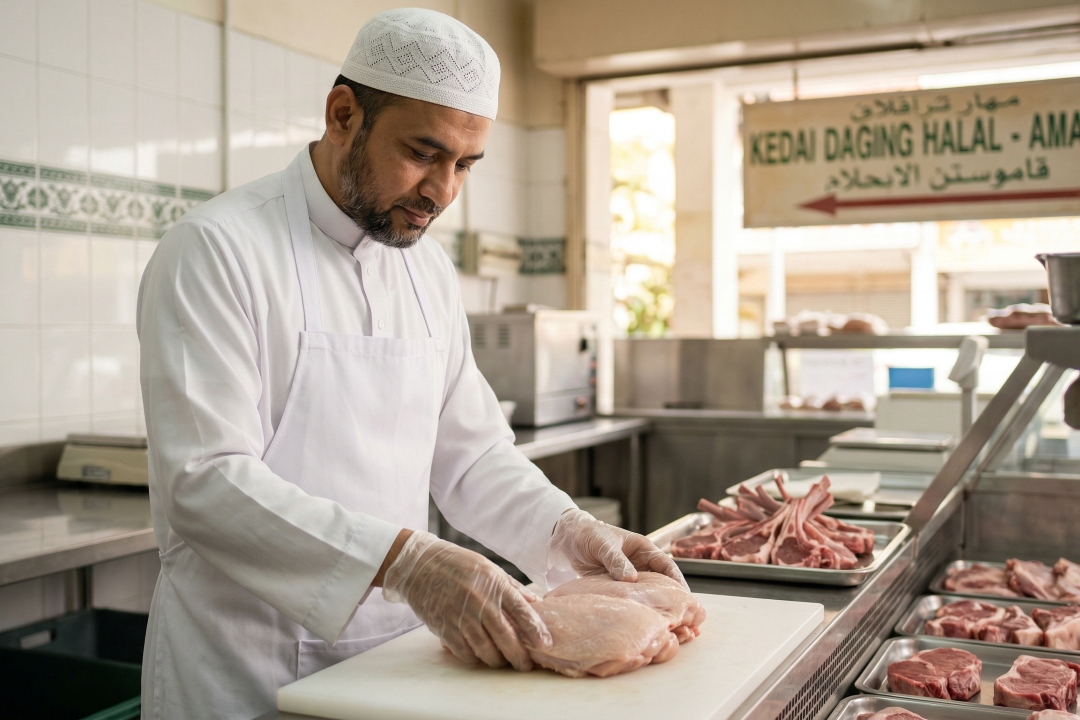
Halal kitchen and processing requirements
Equipment and utensils used in Halal food production must not have been used to prepare non-Halal items. If they have, ritual cleansing (sertu or samak) is required before they can be used again. This extends to production lines, storage facilities, and transport — all of which may be assessed as part of a Halal audit.
Halal certification in Southeast Asia
Halal certification is issued by country-specific bodies. The key authorities across DPO’s markets are:
- Malaysia — JAKIM (Jabatan Kemajuan Islam Malaysia)
- Indonesia — BPJPH(Badan Penyelenggara Jaminan Produk Halal) & MUI (Majelis Ulama Indonesia)
- Singapore — MUIS (Majlis Ugama Islam Singapura)
- Thailand — CICOT (Central Islamic Council of Thailand)
- Philippines — IDCP, IADP, and other accredited bodies
Each body has its own standards and audit processes. Ingredient suppliers entering these markets should ensure their products carry the relevant country certification, not simply an international Halal mark.
What Is Kosher?
‘Kosher’ comes from the Hebrew word meaning ‘fit’ or ‘proper’. It refers to food that complies with Jewish dietary law (Halacha). When comparing halal vs kosher, this is where the most significant operational differences begin to emerge — particularly around the separation of food categories, which has no parallel in Halal law.
What Kosher permits and prohibits
- Beef, lamb, goat, and poultry are permitted, subject to correct slaughter
- Pork is strictly prohibited
- Seafood is restricted — only fish with both fins and scales are permitted. Shellfish, crustaceans (crab, shrimp, lobster), and molluscs are forbidden
- Dairy is permitted, but must never be combined with meat in the same dish, preparation surface, or utensils
- Alcohol is generally permitted, provided all ingredients are Kosher. Grape-based products (wine, juice, vinegar) must be produced under rabbinical supervision
- Certain animal fats (chelev) and the sciatic nerve (gid hanasheh) are forbidden
- Animal blood is prohibited; it must be fully removed by salting or broiling the meat
- In most Kosher meat operations outside Israel, the hindquarters are sold to non-Kosher markets rather than processed for Kosher use. This is because both the sciatic nerve and the majority of forbidden fats are located there, making correct removal extremely difficult and costly.
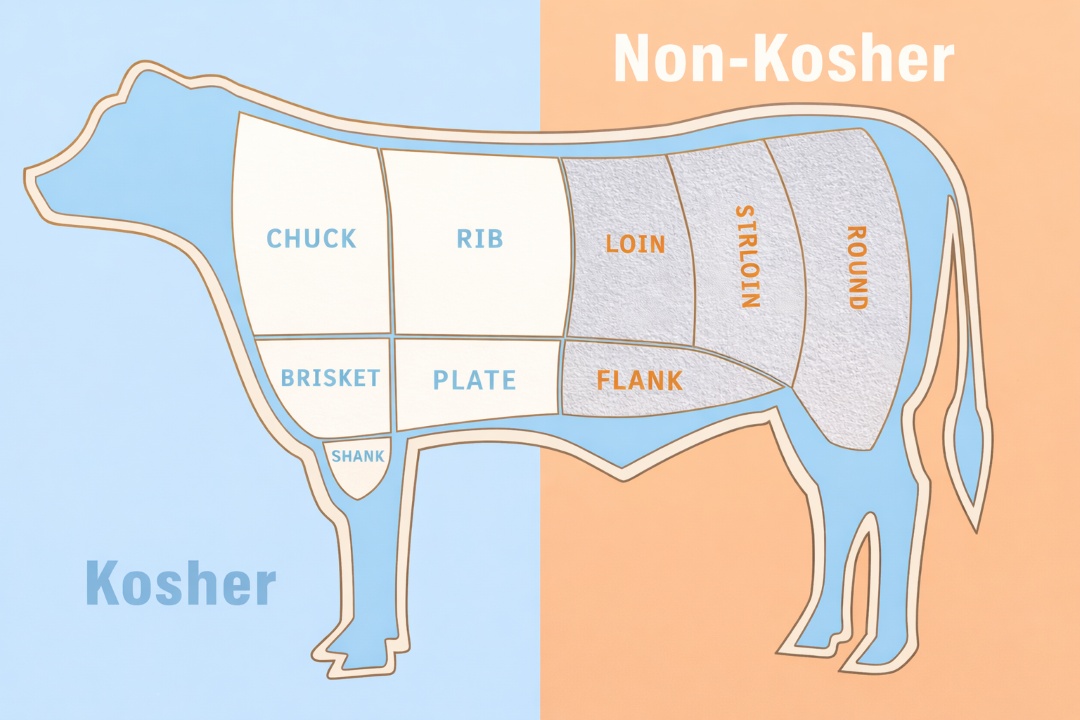
The Kosher slaughter method (Shechita)
Kosher slaughter must be performed by a trained and certified Jewish slaughterer known as a shochet. The cut must be made with a perfectly smooth, nick-free blade (chalef) in a single, uninterrupted stroke. Any pause or pressure during the slaughter renders the meat non-Kosher (treif). The animal must also be inspected post-slaughter for internal defects (bedika); animals found to have certain conditions are disqualified.
The meat-dairy separation rule
One of the most operationally significant Kosher rules — particularly for food manufacturers — is the absolute prohibition on combining meat and dairy. This applies to ingredients, preparation surfaces, cookware, and serving equipment. Kosher-observant production facilities typically maintain entirely separate lines, with different utensils and equipment for meat and dairy products. Some interpretations also require a waiting period between consuming one and the other.
Kosher certification bodies
Unlike Halal, which is regulated nationally in most markets, Kosher certification is issued by a wide range of rabbinical organisations globally. The most widely recognised international bodies include:
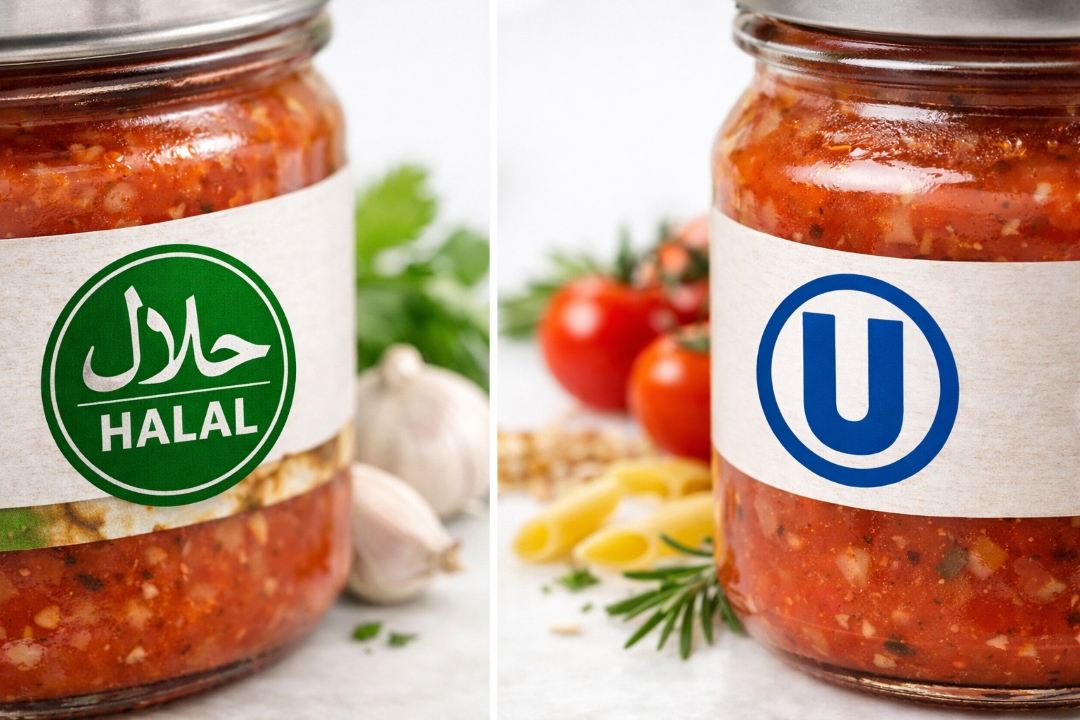
- OU (Orthodox Union) — the world’s largest Kosher certifier
- OK Kosher Certification
- KOF-K Kosher Supervision
- Star-K Kosher Certification
For food businesses supplying into markets with significant Jewish communities — including parts of the United States, Europe, Israel, and Australia — one of these certifications is typically required.
The Key Differences Between Halal vs Kosher
The table below summarises the most important differences between halal and kosher — covering religious law, permitted foods, slaughter methods, certification, and market relevance across Southeast Asia.
Halal vs Kosher Certification: What Food Businesses Must Know
Can a product be both Halal and Kosher?
Yes — and dual-certified products are increasingly common, particularly for ingredient manufacturers targeting global markets. However, when it comes to halal vs kosher dual certification, the alcohol rule is the most significant point of conflict: Kosher law permits alcohol if the ingredients are Kosher, while Halal law prohibits it entirely. Any product containing alcohol cannot be Halal-certified, regardless of its Kosher status.
Manufacturers pursuing dual certification should engage both a Halal certification body and a Kosher certifier early in their product development process to identify potential conflicts.
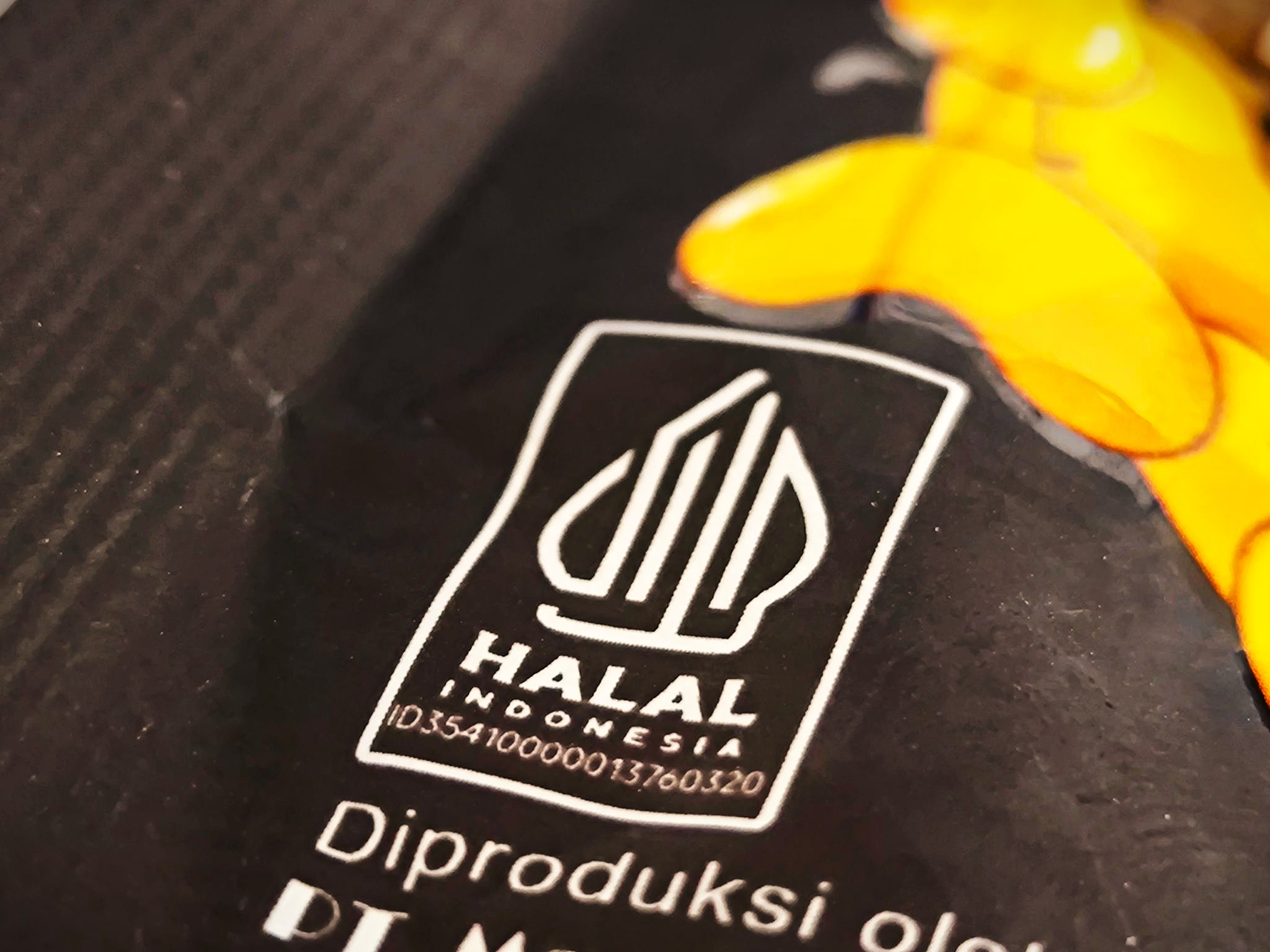
Halal compliance in Southeast Asia
For food businesses operating across DPO’s markets — Malaysia, Indonesia, Thailand, the Philippines, Vietnam, and Sri Lanka — Halal compliance is not optional. Muslim consumers represent the majority in several of these markets, and Halal certification is increasingly a procurement requirement at the retail, foodservice, and institutional level. Ingredient suppliers without valid Halal certification from the relevant national body will face significant barriers to market entry.
Kosher as a market differentiator
While Kosher compliance is not a primary requirement in Southeast Asian markets, it is an important consideration for ingredient suppliers and food manufacturers targeting export markets — particularly the United States, Europe, Israel, and Australia. In these markets, Kosher certification can serve as a meaningful quality signal and open access to dedicated retail channels.
Label reading and ingredient sourcing
A Kosher-certified ingredient is not automatically Halal-compliant — and vice versa. This is one of the most critical practical distinctions in the halal vs kosher comparison for manufacturers. When building a compliant product, each ingredient in the formulation must carry the appropriate certification for the target market. This applies to flavourings, emulsifiers, enzymes, gelatine, and other processing aids, which are common sources of compliance issues.
💡 Industry note: Gelatine, emulsifiers, and enzyme-derived ingredients are among the most frequently flagged items in Halal and Kosher audits. If you are unsure whether a specific ingredient is compliant, consult your certification body before it reaches your formulation. |