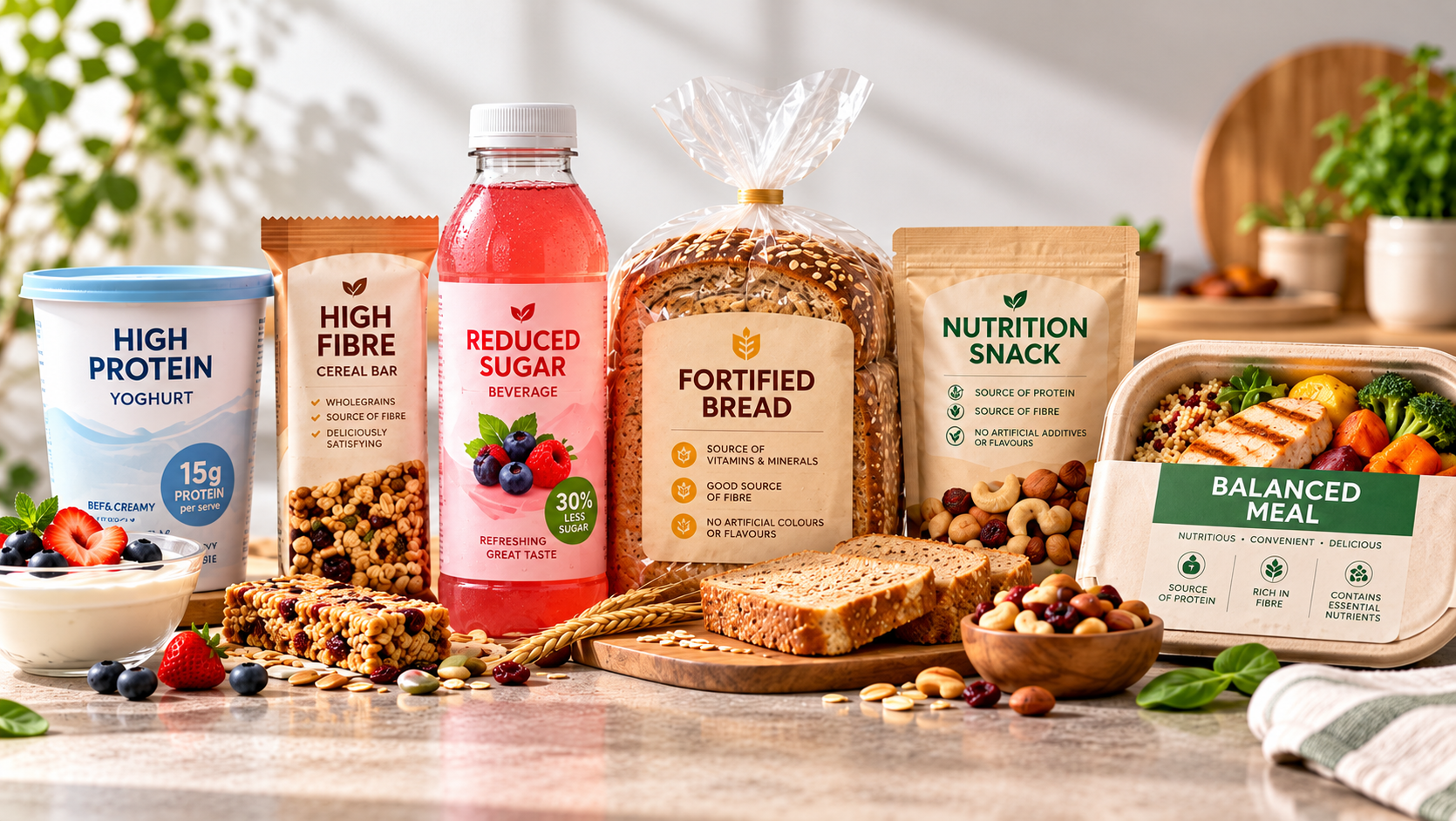
What makes a food product better for consumers? Is it a higher protein content, more fibre, less sugar, or simply a better balance of nutrients?
For food manufacturers, the answer is rarely that straightforward. Nutrition food needs to do more than look good on a nutrition label. It needs to taste good, work in the right application, meet regulatory requirements, reach the market reliably and, ultimately, fit the way people eat.
This makes nutrition innovation less about finding one “better” ingredient and more about connecting the right solutions across the food development journey.
With World Food Day 2026 highlighting the role of innovation in creating access to sufficient, diverse, safe and nutritious foods, it is worth looking beyond the formulation itself — and considering what it takes to bring better nutrition food from an idea to the consumer.¹
Here are 6 key areas food manufacturers should consider when developing nutrition food products.
Nutrition Food Starts with the Right Goal
Before choosing an ingredient, manufacturers need to understand what they want the product to achieve.
It could be increasing fibre or protein, reducing sugar or sodium, improving the nutritional profile, or developing a product that addresses a particular eating occasion or consumer need.
Healthy diets are not defined by one nutrient or ingredient. Their composition can vary according to individual characteristics, preferences, cultural context, locally available foods and dietary customs, while still following core nutritional principles.²
This means the starting point is not simply “Which ingredient should we use?”
It is “what nutritional need are we trying to address, and what makes sense for this product?”
Finding the Right Solution for Nutrition Food
Once the nutritional objective is clear, ingredient selection becomes an important part of the process.
However, an ingredient that offers a particular nutritional benefit still needs to work within the finished product. Changes to formulation can affect taste, texture, appearance, stability and overall product performance.
Food reformulation, for example, can involve changing the composition or processing of a food or beverage to improve its nutritional profile or reduce nutrients of concern such as sugars, salt, saturated fats or trans fats.³
The challenge, therefore, is not simply finding an ingredient with a desirable benefit. It is to find a solution that works for the product.
Making Nutrition Food Work in the Real Application
This is where an idea starts becoming an actual food product.
A solution that performs well in a beverage may behave very differently in a bakery product, snack or dairy application. Manufacturers may need to explore different ingredient combinations, recipes, processing conditions and formulations before finding the right balance.
This is where application and recipe development can add value, helping manufacturers explore how a nutritional solution can work within a specific food or beverage concept.
After all, consumers do not experience individual ingredients. They experience the taste, texture, appearance and convenience of the finished product.
Making Nutrition Food Relevant to the Market
Even a well-formulated product needs to make sense for the people it is intended for.
Consumer preferences, eating habits, price expectations, local food cultures and consumption occasions can all influence how a product should be developed and positioned.
A nutrition-focused product designed for breakfast occasion, for example, may require a very different approach from one intended as an afternoon snack or convenient on-the-go beverage.
This is why nutrition innovation is not purely a technical exercise. Understanding the market matters too.
For manufacturers, the opportunity is not simply to make a product more nutritious, but to make it relevant, appealing and accessible to the intended consumer.
Supporting Nutrition Food with the Right Regulatory Expertise
Once the product begins to take shape, another question comes into focus: can it meet the requirements of the market?
Ingredient compliance, nutrition claims, labelling, food safety and market-specific regulations can all influence how a product is formulated and communicated.
These considerations are particularly important when manufacturers are developing products for more than one market, where requirements and expectations may differ.
Having scientific and regulatory support early in the development process can therefore help manufacturers navigate these considerations alongside formulation, rather than treating compliance as a final checkpoint.
Bringing Nutrition Food from Development to Market
There is one more part of the journey that can easily be overlooked: getting the product to consumers reliably.
Ingredient availability, inventory planning, storage, distribution and delivery can all influence whether a product can be supplied consistently, particularly when manufacturers are operating across multiple markets.
Innovation within the food system does not happen only in the formulation room. How food is stored, transported and distributed can also play a role in bringing nutrition food to consumers.
This is where supply chain capabilities become part of the wider nutrition conversation.
Because developing a better product is one thing. Getting it to the right market, at the right time and in the right way is another.
From Nutrition Ideas to Market-Ready Solutions
Creating better nutrition food is not a single-step process. Having the right capabilities across the development and commercialisation journey can help turn a promising nutrition concept into a practical, market-ready food solution.
At DPO International, we provide full-suite market enablement for food businesses — supporting manufacturers beyond ingredient supply with Application & Recipes, Scientific & Regulatory Affairs, Supply Chain Management, Marketing Support and more.
Talk to us today to explore how we can support your nutrition food journey from concept to market.
Frequently Asked Questions
Food manufacturers should consider more than the nutritional benefit of an ingredient. They also need to evaluate the product application, taste and texture, consumer needs, regulatory requirements, ingredient availability and supply chain to ensure the final product is practical and market-ready.
The right ingredient depends on the nutritional objective, product format and intended consumer. Manufacturers should consider how an ingredient’s nutritional benefits work alongside factors such as taste, texture, stability and overall product performance.
DPO International can support manufacturers with ingredient solutions as well as Application & Recipes expertise to explore how suitable solutions can work within specific food and beverage applications.
An ingredient that provides a nutritional benefit still needs to perform effectively in the finished product. Application and recipe development can help manufacturers evaluate ingredient combinations, formulations and product concepts to achieve the desired nutritional and sensory outcomes.
Manufacturers may need to consider ingredient compliance, nutrition claims, labelling, food safety and market-specific regulatory requirements. These requirements can influence both formulation and how the finished product is communicated to consumers.
Scientific & Regulatory Affairs support can help manufacturers navigate these considerations during product development rather than treating regulatory compliance as a final step.
A nutrition-focused product also needs a reliable supply of ingredients and a practical route to market. Inventory planning, storage, distribution and delivery can help manufacturers maintain consistent supply and support expansion into different markets.
DPO International’s Supply Chain Management capabilities can support food businesses beyond ingredient sourcing, helping connect product development with reliable market supply.
DPO International provides full-suite market enablement for food businesses, supporting manufacturers beyond ingredient supply with capabilities including Application & Recipes, Scientific & Regulatory Affairs, Supply Chain Management, Marketing Support and more.
Looking to develop a nutrition-focused food product or explore new solutions? Contact us to discuss how we can support your journey from concept to market.