Many people know that sugar is linked to cavities, but few understand how tooth decay happens and why some sweeteners behave very differently in the mouth. If you’ve ever searched “Can sugar cause tooth decay?”, “How can I reduce sugar intake?”, or “Which foods cause cavities?”, you’re asking the same questions millions of consumers search online every year.
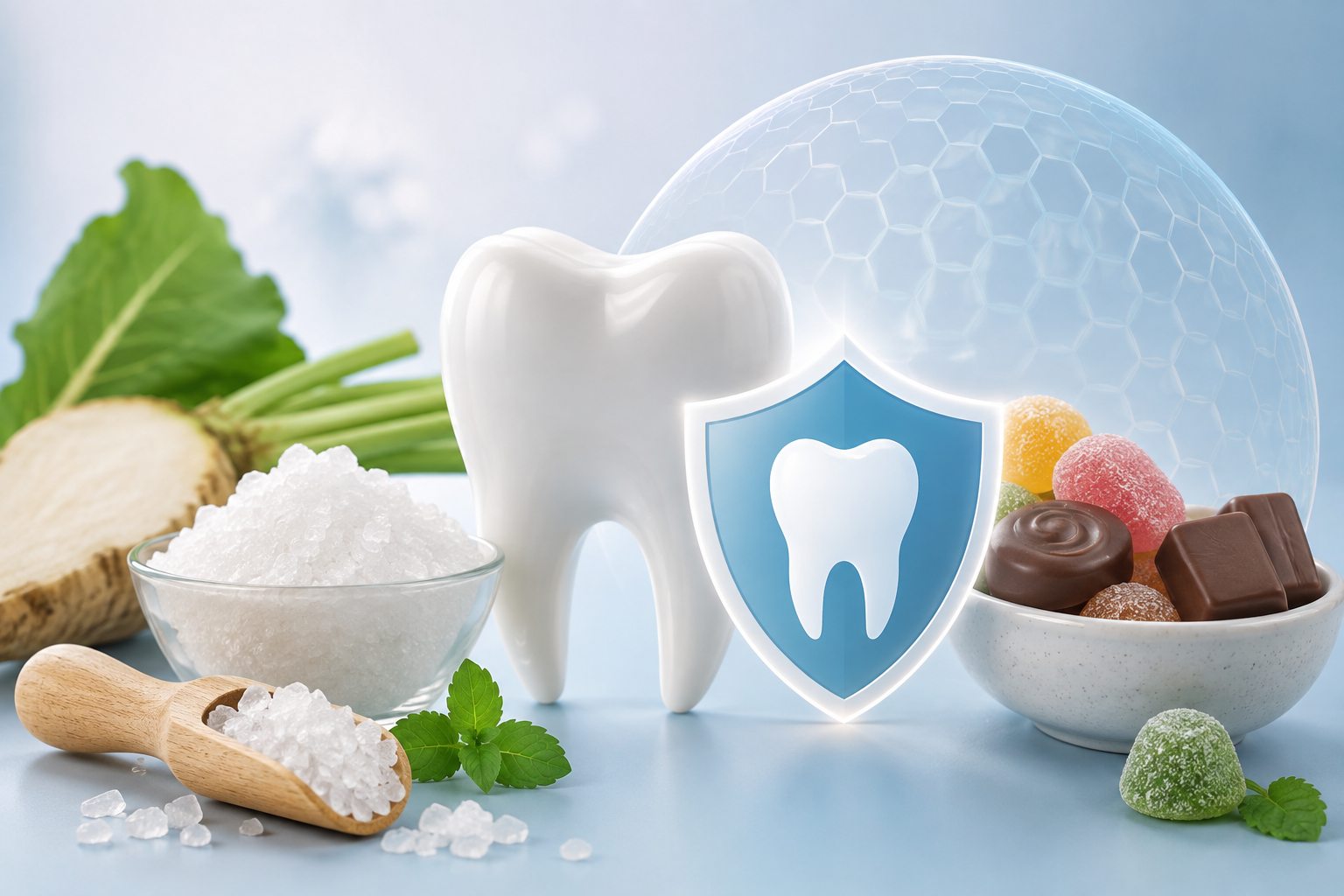
The good news? Not all sweeteners are created equal. Advances in food science have led to alternatives such as isomalt, a tooth-friendly sugar replacer that offers sweetness without supporting the same cavity-causing processes associated with regular sugar.
Can Sugar Cause Tooth Decay?
Yes.
Tooth decay occurs when bacteria naturally present in the mouth feed on fermentable sugars such as sucrose, glucose, and fructose. As these bacteria metabolize sugar, they produce acids that lower the pH of dental plaque.
When plaque pH drops below a critical level (approximately pH 5.5), minerals begin leaving the tooth enamel in a process called demineralization. Over time, repeated acid attacks can lead to cavities.
In simple terms:
- Eat sugar-containing foods or beverages.
- Oral bacteria consume sugar.
- Acids are produced.
- Enamel loses minerals.
- Cavities may develop.
This is why dentists consistently recommend limiting frequent consumption of sugary snacks and drinks.
Which Foods Cause Tooth Decay?
Foods and beverages that contain readily fermentable sugars are most commonly associated with cavities, including:
- Sugar-sweetened beverages
- Candies and confectionery
- Sweet bakery products
- Sweetened fruit drinks
- Sticky snacks that remain on teeth for long periods
The risk increases when these foods are consumed frequently throughout the day because the teeth are exposed to repeated acid attacks.
How Can You Prevent Tooth Decay Without Giving Up Sweetness?
Consumers are increasingly looking for ways to enjoy sweet foods while reducing the impact on oral health.
Some effective strategies include:
- Limiting added sugars
- Maintaining good oral hygiene
- Drinking water after sugary foods
- Choosing products made with tooth-friendly sweeteners
- Replacing sugar with scientifically validated sugar alternatives
One such alternative is isomalt.
What Is Isomalt?
Isomalt is a sugar replacer belonging to the polyol (sugar alcohol) family. It is derived from sugar beet and provides sweetness while offering a significantly different metabolic and dental profile compared with conventional sugars.
Today, isomalt is widely used in:
- Sugar-free candies
- Reduced-sugar confectionery
- Lozenges
- Chocolates
- Functional foods
- Better-for-you snacks
How Does Isomalt Function Differently Than Sugar?
This is where the science becomes particularly interesting.
1.Oral Bacteria Cannot Easily Ferment Isomalt
Traditional sugars such as sucrose are rapidly fermented by decay-causing bacteria.
Isomalt, however, is metabolized very slowly and inefficiently by oral microorganisms. As a result, significantly less acid is produced in dental plaque.
Why This Matters
Less acid production means:
- Reduced pH drop in the mouth
- Reduced enamel demineralization
- Lower cavity risk
This is the primary reason isomalt is considered non-cariogenic (not cavity-causing).
2.Isomalt Helps Maintain Tooth Mineralization
The European Food Safety Authority (EFSA) evaluated scientific evidence on sugar replacers including isomalt and concluded that replacing sugars with polyols such as isomalt helps maintain tooth mineralization by reducing tooth demineralization.
In practical terms:
Regular Sugar | Isomalt |
Rapidly fermented by oral bacteria | Poorly fermented by oral bacteria |
Produces plaque acids | Minimal acid production |
Promotes demineralization | Helps reduce demineralization |
Higher cavity risk | Tooth-friendly profile |
3. Studies Shows Protective Effects Against Cavity Development
Recent research published in the peer-reviewed Dentistry Journal evaluated toothpaste formulations containing 10% isomalt in an in situ microbial caries model. Compared with control treatments, the isomalt-containing formulations showed significantly lower enamel demineralization under cariogenic . While the study design does not isolate the effect of isomalt from other ingredients such as fluoride and cetylpyridinium chloride (CPC), the findings support the use of isomalt in tooth-friendly formulations and are consistent with its recognized non-acidogenic and non-cariogenic properties.
Additionally, these findings are consistent with the European Food Safety Authority (EFSA)’s conclusion in 2011 that replacing sugars with isomalt and other approved sugar replacers helps maintain tooth mineralization by reducing tooth demineralization. EFSA attributed this benefit to the non-cariogenic nature of these sweeteners, which are not readily fermented by oral bacteria and therefore produce less enamel-damaging acid than conventional sugars. Notably, EFSA considered isomalt part of a broader group of tooth-friendly sugar replacers and did not conclude that it provides greater dental benefits than other approved .
These findings are consistent with decades of scientific understanding that polyols can provide oral health advantages when replacing conventional sugars.
How Many Grams of Sugar Should You Consume Per Day?
Health authorities generally recommend limiting free sugar intake and reducing consumption where possible to support overall health, including oral health. Frequent sugar exposure, rather than a single occasion, is often a key contributor to cavity formation.
As per WHO recommendations, free sugars should be limited to less than 10% of total daily energy intake—approximately 50 g based on a 2,000-calorie diet.
A further reduction to 5% or less—approximately 25 g—may provide additional health benefits.
This is why many consumers are actively searching for:
- Reduced-sugar products
- Sugar-free confectionery
- Better-for-you sweeteners
- Functional ingredients with added benefits
A Smarter Choice for Modern Consumers
Today’s consumers are not looking to eliminate enjoyment.
They are looking for:
✅ Great taste
✅ Better nutritional choices
✅ Reduced sugar intake
✅ Tooth-friendly ingredients
✅ Products aligned with healthier lifestyles
Isomalt helps manufacturers deliver these benefits while maintaining sweetness and product functionality.
Developing Tooth-Friendly, Sugar-Reduced Products with DPO International
At DPO International, we understand that consumers want products that balance enjoyment with smarter nutritional choices. We help food and beverage manufacturers to translate sugar-reduction goals into commercially viable product concepts. Isomalt can be considered for applications where sugar reduction, bulk, sweetness and tooth-friendly positioning are important, including sugar-free and reduced-sugar confectionery, candies, lozenges, chocolate and selected functional products.
However, isomalt should be evaluated as part of the complete formulation rather than treated as a simple one-for-one sugar replacement. Sweetness intensity, processing behavior, labelling requirements and permitted claims may differ by product and market.
DPO International can support manufacturers in identifying suitable ingredient solutions and formulation approaches based on their applications, target markets and product objectives. By replacing conventional sugar with isomalt, brands can create products that address growing consumer concerns around sugar reduction and oral health while maintaining the taste experience consumers expect.
Yes. Oral bacteria ferment sugar and produce acids that demineralize tooth enamel and contribute to cavity formation.
Choose reduced-sugar alternatives, read nutrition labels, limit sugary drinks, and opt for products formulated with sugar replacers such as isomalt.
Foods rich in fermentable sugars, particularly sticky sweets and sugary beverages, are major contributors to cavities.
Isomalt is a sugar replacer derived from sugar beet that provides sweetness with a tooth-friendly profile.
Scientific evidence indicates that isomalt is non-cariogenic because oral bacteria cannot efficiently convert it into the acids that drive tooth demineralization.
Yes, isomalt can generally replace sugar on a 1:1 weight basis in many formulations because it provides similar bulk and functionality. However, isomalt is only about 45 to 65% as sweet as sucrose, so manufacturers often combine it with high-intensity sweeteners such as sucralose, stevia, or acesulfame-K to achieve sugar-like sweetness.
Isomalt is widely used in:
- Hard-boiled candies and lollipops
- Chewing gum and coated products
- Chocolates and confectionery
- Compressed mints and tablets
- Baked goods
- Breakfast cereals
- Fruit spreads
- Frozen desserts
- Nutritional and reduced-sugar products
Its low hygroscopicity helps maintain product stability and prevents stickiness, making it particularly valuable in confectionery applications.
Yes. Isomalt is one of the most commonly used polyols in sugar-free confectionery, especially hard candies, lozenges, mints, and chewing gum. It provides bulk, excellent processing characteristics, a clean taste profile, and improved shelf life due to its low moisture absorption.
When using isomalt, manufacturers should consider:
- Lower sweetness than sugar, often requiring combination with high-intensity sweeteners.
- Cooling effect, although less pronounced than many other polyols.
- Digestive tolerance, as excessive consumption of polyols may cause gastrointestinal discomfort in sensitive individuals.
- Processing conditions, including moisture management, desired texture, and sweetness profile.
- Regulatory and labeling requirements for polyol-containing products.
Yes. Isomalt is non-cariogenic, meaning it is not readily fermented by oral bacteria and does not promote tooth decay. Subject to local regulatory requirements, products formulated with isomalt may be eligible for tooth-friendly or dental-health-related claims.
Labelling requirements vary by country and region. In many markets, products containing polyols such as isomalt must:
- Declare the polyol in the ingredient list.
- Include the statement “Excessive consumption may have a laxative effect” when polyol levels exceed specified regulatory thresholds.
- Comply with local requirements for nutrition facts, sugar-free claims, and carbohydrate declarations.
Manufacturers should always verify the applicable regulations in their target market before product launch.
Yes. Isomalt has a very low glycemic and insulinemic response compared with sucrose, making it a popular ingredient in products designed for consumers seeking better blood glucose management. Nevertheless, finished-product nutritional claims should comply with local regulatory requirements and be supported by complete formulation.